


How Togo has become a new entry point for weapons sent by Russia to Mali

On July 1, an open-source investigations account posted a satellite image taken on June 16 of the port of the Baltiysk Naval Base, located in the Russian enclave of Kaliningrad, which lies between Poland and Lithuania. The image shows a Russian cargo ship, the Mikhail Britnev, being loaded with “armoured fighting vehicles and personnel carriers”.
The Mikhail Britnev is part of the fleet of Russian ships that has been under United States sanctions since Russia invaded Ukraine. The ship is also on the sanctions list on the site of the Office of Foreign Assets Control (OFAC), a US government organisation that enforces economic and trade sanctions.
The Mikhail Britnev was likely carrying cargo bound for Mali, says Hasret Kargın, Senior Researcher on Africa at Mintel World, an open-source intelligence firm. In Mali, it would be used by the Malian Armed Forces (FAMA) and their allies, the Africa Corps, a paramilitary organisation controlled by the Russian government that replaced Yevgeny Prigozhin’s Wagner Group in Mali.
“Considering the operational structure on the ground, it is likely that both actors will use the equipment,” the researcher told the FRANCE 24 Observers team.
A ship traced by the Royal Navy
The Mikhail Britnev left the Baltiysk port on June 18, bound for the Atlantic Ocean, according to data from the website Global Fishing Watch, which can track the ships’ position using their AIS signals (Automatic Identification System).

The Mikhail Britnev appears to have been escorted through the English Channel by the Russian Navy’s Aleksander Shabalin, a Ropucha-class landing ship. The two Russian ships were trailed and surveilled by a British naval vessel, the HMS Somerset, according to the Royal Navy’s website.

Somewhere off the coast of Brittany, the Mikhail Britnev cut off its AIS transponder, meaning that it was impossible to follow its route until July 8, when the ship turned its AIS transponder back on. By then, it was located in the waters alongside the Port of Lomé in Togo. The cargo ship docked at the port on July 9.
Port of Lomé, an entry point for a new logistics corridor
This shows that the Port of Lomé has become an entry point for a “new logistics route” for the delivery of Russian military vehicles to Mali, says analyst Kargın.
As the FRANCE 24 Observers team explored in a previous investigation, military equipment shipped by Russia to Mali previously went through Guinea and then the west of Mali. The cargo was unloaded at the Port of Conakry in Guinea and then transported in convoys along a 995-kilometre logistics corridor to Bamako, the capital of Mali.
Read moreHow a Russian ship under sanctions delivered armoured vehicles to Mali
The new route, though eastern Mali, is twice as long: 1,842 kilometres according to Google Earth.
“The convoy departed from the Port of Lomé in Togo, passed through Bobo-Dioulasso in Burkina Faso, and entered Mali from the Sikasso region. It then followed the Bougouni and Ouelessebougou route to reach the capital, Bamako,” said Hasret Kargın. The Malian part of the route was confirmed in the 8pm news programme on July 25 of ORTM, Malian public television. ORTM reported that the convoy took 10 days to arrive at its destination.

Kargın said that both logistical and security considerations likely played a role in the adoption of this new route.
“The smaller capacity of the Port of Conakry and the long waiting times for ships may have played a role in the use of this new route.
Although the new route is longer in distance compared to the Guinea (Conakry) line, certain changes have taken place in terms of risk and security strategy in recent years. Following JNIM’s blockade in Mali [Editor’s note: Jama’at Nusrat al-Islam wal-Muslimin, a jihadist group linked to al Qaeda], this route began to be used as an alternative to the traditional western routes. Despite the disadvantage in distance, many fuel convoys have recently been reaching the capital via this new line instead of the western route.
Security improvements along the route and convoy habits formed over the past year appear to have ensured that this military shipment was also carried out safely from the direction of Sikasso [Editor’s note: located close to Mali’s western border].”
Cooperation between Russia and Togo
Is it possible that Guinea refused to allow this material to pass through its ports?
The experts are divided on this question. While Kargın says that, for the time being, there is no concrete proof that Guinean authorities refused to let the Russian military material transit through their country, French news magazine Jeune Afrique reported on July 24 that Conakry reportedly expressed opposition to accepting a cargo under sanction at their ports.
The establishment of this new route through Togo does indicate cooperation between Togo and Russia, Kargın says:
“We know that Russia and Togo have recently developed their relations within the framework of the Military and Technical Cooperation Agreement signed in 2025 and the Treaty on the Basis of Relations, which was signed in Moscow in November 2025 and entered into force in April 2026, and that organisations such as the Africa Initiative [Editor’s note: a Russian news agency that has engaged in influence operations] are operating in Togo. And the volume of the shipment indicates that coordination was established between the authorities of the two countries for the transit.”
Satellite images show the Mikhail Britnev being unloaded
What exactly was the Mikhail Britnev carrying?
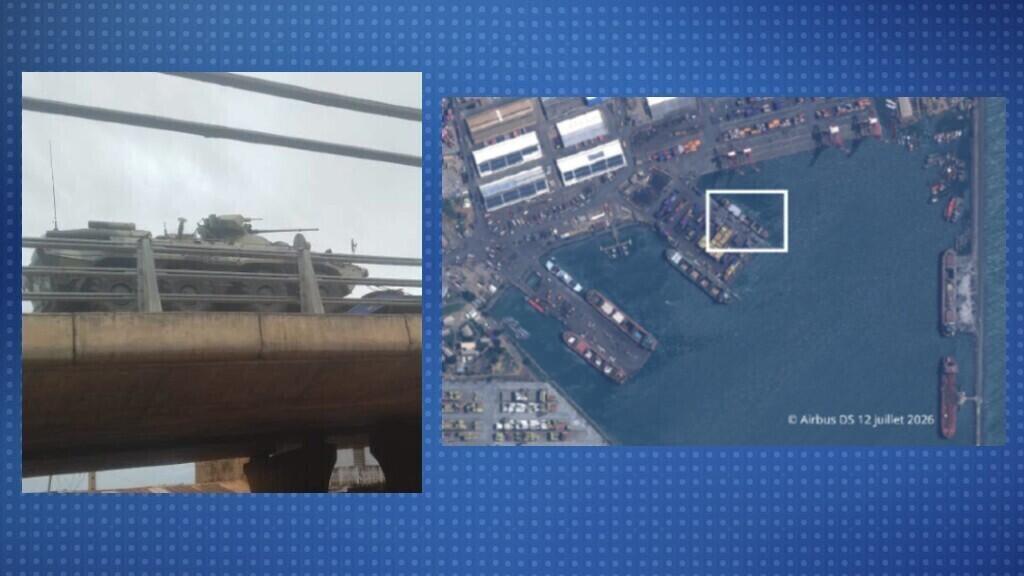
An image of the cargo being unloaded was captured on July 12 by a satellite belonging to Airbus Defence and Space, a European company.

This image, which Airbus DS provided to our team, appears to show two tanks in the ship’s hold. Their dimensions – a length of just over seven metres and a width of three metres – could match those of the Russian infantry fighting vehicle BMP-3. This model also appears in the ORTM report on the convoy’s arrival in Bamako.
Two other armoured vehicles shown on the port appear to have a length of 6.7 metres and a width of just over 3 metres. That would align with a BMP-2, an amphibious Russian fighting vehicle.
Armoured trucks and vehicles
Other Russian military vehicles, including a Ural-63704-0011 Tornado-U transport truck, can be identified in videos of the weapons convoy that left the Port of Lomé, shared by an open-source investigator on July 22, says Marc Chassillan, a weapons system expert. The footage also shows Tigr-M armoured 4X4s, says Benjamin Gravisse, a political scientist and author of the blog Red Samovar, a site specialised in covering the Russian military.

Using a series of photos posted on Facebook on July 23, the FRANCE 24 Observers team was able to geolocate the convoy as it crossed a viaduct in Sikasso, a town in western Mali.
You can identify the viaduct by looking at the T-shape of its pylons, which are also equipped with black gutters. Both appear in this image of the viaduct posted by a development bank’s Instagram account.

In the photos taken in Sikasso, you can also see a BTR-82A, another Russian infantry fighting vehicle.

Chinese armoured vehicles
A report by the ORTM 1 on the convoy’s arrival in Bamako, dated July 25, also proves that some Chinese-made vehicles were part of this shipment. In the footage, you can see VP-11 Mine Resistant Ambush Protected vehicles (known as MRAPs), manufactured by the Chinese company Norinco. As revealed by a researcher we spoke to in our previous investigation about Russian arms being shipped to Mali, it seems like Russia is buying some Chinese-made military material for the Malian Armed Forces and the Africa Corps.

Finally, the ORTM 1 report also shows that there were white soldiers present in the convoy. One white soldier appears in one of the machine gun turrets in the Ural truck, while two other white soldiers are sitting in the BMP-3 armoured vehicle.

Pan-African media outlet Jeune Afrique reported that the Africa Corps acted as an escort for part of the convoy’s journey from the Port of Lomé.
This article has been translated from the original in French by Brenna Daldorph.