


Social infrastructure during heatwave: ‘Knock on the door makes the difference between life & death’
Social infrastructure during heatwave: ‘Knock on the door makes the difference between life & death’
One of your browser extensions seems to be blocking the video player from loading. To watch this content, you may need to disable it on this site.


Reading time
1 min
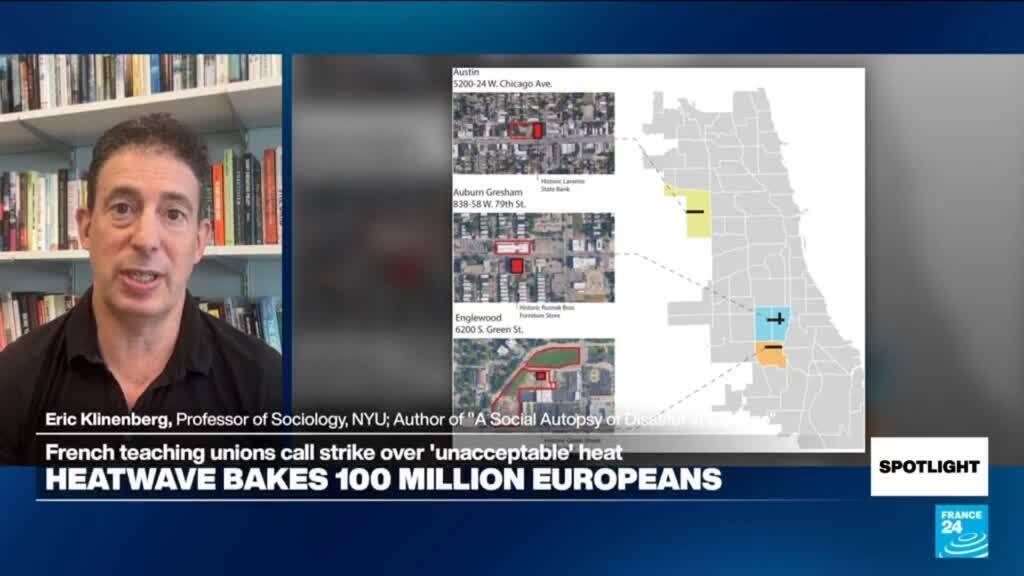
François Picard is pleased to welcome Eric Klinenberg, Professor of Sociology at NYU and Author of “Heat Wave: A Social Autopsy of Disaster in Chicago”. He challenges one of the dominant assumptions surrounding extreme heat: that technological adaptation alone can protect societies from climate change. Drawing on his landmark study of Chicago’s deadly 1995 heatwave, he argues that mortality during extreme heat is shaped as much by the strength of social ties as by meteorological conditions.
Neighbourhoods with similar levels of poverty experienced dramatically different outcomes depending on the quality of their “social infrastructure”: public spaces, institutions and everyday interactions that enable neighbours to recognise vulnerability and care for one another.
Reflecting on France‘s current heatwave, Professor Klinenberg suggests that climate adaptation is fundamentally a social as well as an engineering challenge. While acknowledging improvements in preparedness since France’s traumatic 2003 heatwave, he warns that the accelerating pace of climate change is outstripping the capacity of cities to adapt. Rising temperatures expose not only weaknesses in urban design but also deeper inequalities, social isolation and the invisibility of the most vulnerable. His central argument is that resilience depends not simply on cooling technologies, but on communities capable of transforming social connection into collective protection.
