


India’s Hindu nationalists take 17th-century king as new anti-Muslim symbol

A few hundred men paraded on motorcycles through the streets of Sangareddy, in the southern Indian state of Telangana, on May 29, 2026. They were supporters of the Rashtriya Swayamsevak Sangh, or RSS, the foremost organisation within the Hindu nationalist movement and the ideological backbone of the ruling Bharatiya Janata Party (BJP) – the Hindu nationalist party of Indian Prime Minister Narendra Modi.
Wearing saffron scarves around their necks, they rode down the roads waving their signature double-pennant flags, also saffron – the colour of the BJP.
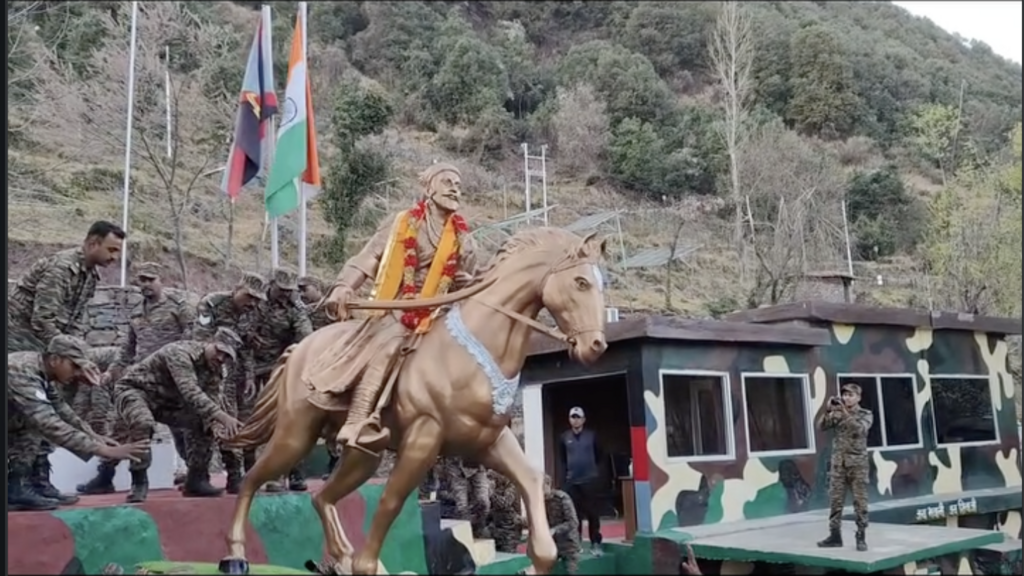
Since 2022, hundreds of statues of King Chhatrapati Shivaji Maharaj – some of them towering up to 27 metres – have emerged across several towns and cities, including in Telangana and Ladakh, a northern Indian state bordering Pakistan and China.
These statues are sometimes erected in secret by nationalist groups, at times with the complicity of local authorities and elected officials and in some instances, with the assistance of the military.
Shivaji is a prominent 17th-century figure in Maharashtra, a state in western India. Today, he serves as a key point of reference for local political parties across the entire political spectrum. He is widely known for his military campaigns against the Muslim Mughal emperor Aurangzeb, who is commonly depicted as a tyrant in popular Indian historical narratives.
However, in the political communication strategy of the Hindu nationalist right, Shivaji has been cast as a symbol of the struggle against Muslims – a minority community heavily targeted by the BJP and the RSS.
‘There has been this Hindu right-wing project aimed at making India a de facto Hindu state’
The New York Times reported that several states governed by Modi’s political party have allocated funds to projects aimed at promoting Shivaji’s legacy.
The narrative the party is trying to push aligns with a clear political agenda, according to Rohit Chopra, a communications professor at Santa Clara University and a member of the advisory board of the Centre for the Study of Organised Hate:
“At this point, this has become a project of state and society. In my opinion, it’s definitely coming from the BJP high command. […] Since the BJP came back to power under Mr. Modi’s prime ministership in 2014, there has been this Hindu right-wing project, which is a hundred-year-old project aimed at making India a Hindu state de facto, as opposed to a secular state. Even if it is constitutionally a secular state, the idea is that the national culture at large should be Hindu, and accepted as such.
There’s been this project to create an overarching pan-Hindu cultural identity, in which Shivaji is a figure who is now being recast as a Hindu nationalist figure who has significance not just for Maharashtra but also for all Hindus and all of India. So there’s this new kind of landscape and topography where these pan-Hindu icons are being recast and reshaped through statues. […] It is a state project, but there are some different cultural organisations also involved.”
Chopra said that the RSS’s narrative surrounding the Maratha king is, moreover, “historically completely inaccurate”:
“That is reading a 20th-century conception of nationalism and ethno-nationalism back into an earlier time, when that logic of our conflation of political and religious identification didn’t exist. Aurangzeb, against whom Shivaji fought, had Hindus in his army, and Shivaji had Muslims in his army. These were regional political battles. The conception of Hinduism that the RSS and the BJP promote is a profoundly modern one, rooted in the 19th and 20th-century conception of religion that conflates religious territory and national identity. That way of looking together religion, territory, land and politics simply did not exist in an earlier period.”
‘Another reminder that minorities don’t have a claim on public space’
Since 2014, religious minorities in India – specifically Muslims and Christians – have been targeted by violence and what Human Rights Watch terms “abusive policies”, such as expulsions and politically motivated prosecutions.
Chopra says the erection of Shivaji statues is part of an ongoing pattern of exclusion targeting these marginalised groups:
“It doesn’t directly insult minorities as such, but it becomes another way in which Muslims, Islam, and Christians are completely excluded from public life and public culture. I doubt anyone will speak up publicly against it because if you are a minority and speak up, the risks are very high. But it is another reminder that they don’t have a claim on public space. […] The idea is that this conception of Hinduism is not just the only way to be a Hindu, but this is also the only authentic way to be an Indian.”
While the erection of statues dedicated to Shivaji serves a clear political agenda, the specific locations chosen for these monuments are equally crucial to the nationalists’ political strategy:
“Telangana is in the south of India, a region that has historically not been a stronghold of the BJP, though they are beginning to make some inroads there in alliance with local parties. So it’s very clear that the goal is to cover the whole of India, and I’m sure that we’ll see one in the east as well.”
This article has been translated from the original in French.