


Iran: Rising regional power or too weak to make peace?
Iran: Rising regional power or too weak to make peace?
One of your browser extensions seems to be blocking the video player from loading. To watch this content, you may need to disable it on this site.


Reading time
2 min
PRESS REVIEW – Monday, July 13: Papers analyse Iran’s strategy against the United States. In Japan, a quiet refuge has emerged for Russian spies. And finally, the story of a dog and its “emotional support duck”…
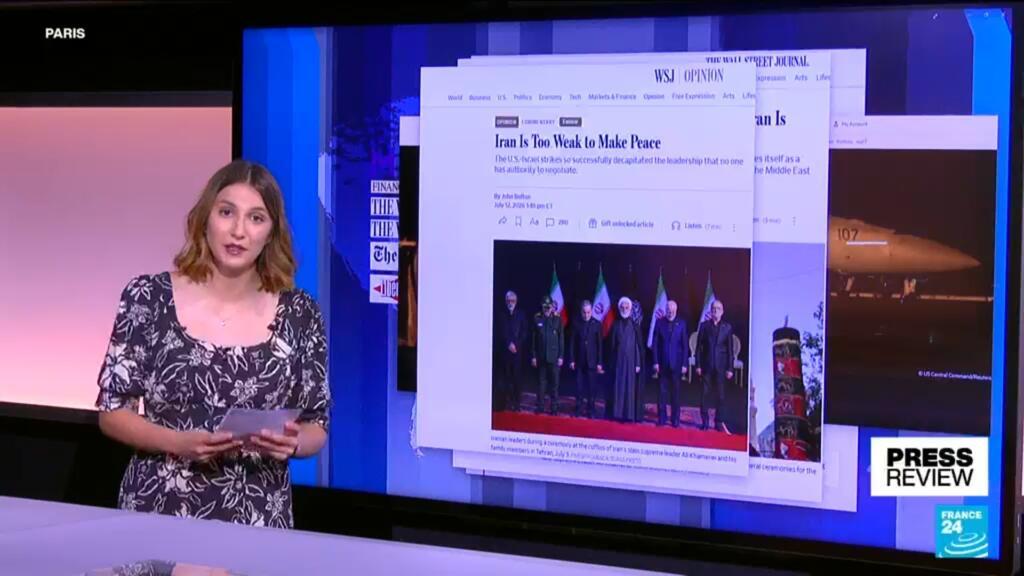
According to The Wall Street Journal, “Tehran sees itself as the winner of a war that would allow it to establish a ‘Pax Iranica’ across the Middle East.” The paper says Iran is seeking “regional domination” and is prepared to escalate in order to maintain control over the Strait of Hormuz.
The journal argues that Tehran is playing the long game, believing that once it emerges as a regional hegemon, sanctions relief from Washington could follow. But for John Bolton, Donald Trump’s former national security adviser, Iran is simply “too weak to make peace”. Writing in The Wall Street Journal, he argues that US-Israeli strikes have “so successfully decapitated the leadership that no one has authority to negotiate”.
According to The New York Times, “hardliners in Iran want to keep fighting America”. The paper says the deaths of a “large portion” of Iran’s hardline leadership have prompted conservatives to “fill the void” by intensifying their confrontation with the United States. They are also portraying compromise as “strategically dangerous and morally illegitimate”.
That leadership “vacuum” is also highlighted by French daily Libération, which says it is fuelling rivalries within the conservative camp. The absence of the Supreme Leader has created “instability and ambiguity” over who truly holds the upper hand in shaping Iran’s domestic and foreign policy.
Next to Japan, an investigation by The New York Times asks, “How Putin Turned Japan Into a Den of Spies”. The report says the Kremlin’s network there was built in part to make it harder for Russia to gather intelligence and obtain technology, including microchips and transmitters used in weapons production.
But dozens of Russian operatives reportedly found a foothold in Japan, attracted by what the paper describes as weak espionage laws and a “flourishing high-tech industry”. The report cites Ukrainian estimates that 90 percent of Russian missiles and drones contain Japanese components. At the centre of the operation, it says, is a Russian military intelligence unit known as the “20th Directorate”.
Finally, The Washington Post tells the heartwarming story of the unexpected friendship between Barley the dog and Louis the duck…
You can catch our press review every morning on FRANCE 24 at 7:20am and 9:20am (Paris time), from Monday to Friday