


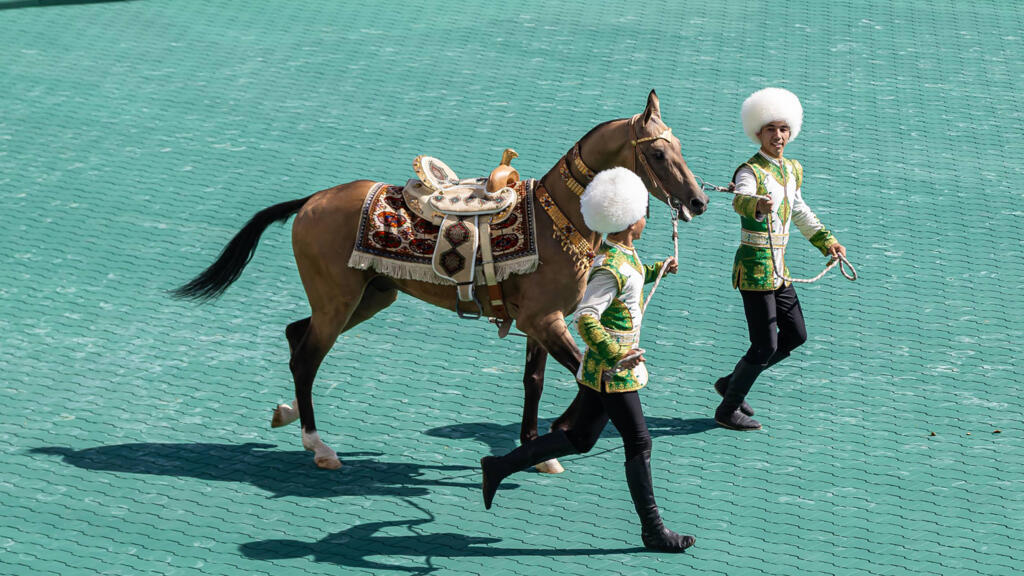
Turkmenistan’s ‘heavenly’ Akhal-Teke horses celebrated in annual beauty pageants

Trainers clad in ornate uniforms and traditional white fur headgear led golden-bedecked stallions round a stage arena at an annual horse beauty pageant in the ultra-closed Central Asian state of Turkmenistan.
The ancient and endangered Akhal-Teke is the subject of a fervent state cult in the desert nation, built up by horse-loving Gurbanguly Berdymukhamedov, ex-president and official father of the nation.
AFP was given rare access to the competition, held at an equestrian complex in the capital Ashgabat and presided over by strongman president Serdar Berdymukhamedov, Gurbanguly’s son.
Crowds of men in matching tracksuits clapped in unison and waved national flags as sand-coloured stallion Hankerven, adorned with jewellery and a traditional carpet, clinched the top prize.
“There are no beauty contests for women in Turkmenistan but there are for horses,” said Ashir, a 70-year-old breeder.
“We Turkmen are known for our carpets and horses,” he told AFP at his stud farm not far from the capital.
“That is why our flag features carpet motifs and our coat of arms depicts the Akhal-Teke.”
The beauty of the species and its importance in Turkmen tradition has earned it a spot on the UNESCO World Heritage List.
Foal rap
The Turkmen authorities discourage residents from speaking without permission to foreign media, with outside journalists rarely allowed into the reclusive country.
Human rights monitors rank the energy-rich former Soviet republic among the world’s most isolated and closed states, alongside Afghanistan and North Korea.
Turkmenistan’s ruling duo – Gurbanguly and Serdar Berdymukhamedov – hold a tight grasp on power.
Read more‘Gateway to Hell’: Turkmenistan urged to plug gas leaks driving climate change
Criticism and opposition of their dynasty are outlawed and the state apparatus has crafted intense personality cults around them.
Horse-obsessed Gurbanguly has churned out numerous books about Akhal-Tekes and even penned a rap song in honour of one of his foals.
“You are like the wind at daybreak, you are like a cherished vision,” he sings in a direct address to the horse, named Rovach.
“You are an inspiration… more precious than gold.”

Another of his horses was named in the Guinness Book of Records for the fastest 10-metre dash while on hind legs – a sprightly 4.19 seconds.
State-controlled media hail the horses as a “strategic priority” and “the unshakeable foundation of national identity”.
Watch moreThe Dictator’s Games: A rare look inside Turkmenistan
The country’s official motto for 2026 is “Independent neutral Turkmenistan is the homeland of purposeful winged horses”.
They are widely referred to as “heavenly horses” – a moniker based on a legend about an Akhal-Teke horse beating a falcon in a mythical race.
‘Glistens’
The vast majority of the estimated 4,000-7,000 Akhal-Tekes worldwide are in Turkmenistan’s state-run stud farms.
An official at the State Organisation for Turkmen Horses told AFP the breed was “on the brink of extinction“, hailing the “interest” that has been shown from the country’s leaders.
It was a “major achievement of national cultural policy,” the official said, to get the “art of Akhal-Teke horse breeding and traditions of horses’ decoration” added to UNESCO’s Intangible Cultural Heritage List.
“The Akhal-Teke is a wonderful sport horse,” a retired vet, 66-year-old Sapargeldy, told AFP at the prize ceremony, declining to give his surname.
“The breed developed in harsh desert climates and has proven itself in endurance riding, dressage and show jumping,” Sapargeldy said.

The horses are characterised by their “large size, long legs, well-developed musculature, slender and elegant head – set on a long, straight neck – expressive eyes, high withers and sturdy hooves,” he added.
“In the sunlight, the horse glistens” thanks to its “fine, hollow-core hair, which reflects light differently.”
Ashgabat draws the origins of the cult to Turkmenistan’s pre-statehood era, when nomadic tribes lived on the desert lands before Russia conquered them in the 19th century.
In modern-day Turkmenistan, monuments have been erected across the country.
Gurbanguly Berdymukhamedov in 2023 ordered a 43-metre-tall golden statue of himself straddling an Akhal-Teke in a pose reminiscent of Napoleon Bonaparte.
The horses are also at the centre of Turkmenistan’s diplomacy.
The few foreign dignitaries who visit are often gifted Akhal-Teke – including former French President Francois Mitterrand, Russia’s Vladimir Putin and China‘s leader Xi Jinping.
(FRANCE 24 with AFP)
For those tired of anxiety-inducing news, The Bright Side highlights initiatives, new discoveries and lighter perspectives to showcase progress and positivity in the world. Whether covering scientific innovations, inspiring profiles or striking images, our stories are always based on rigorously verified facts.