


French startup unveils non-humanoid robot as AI race moves to physical machines

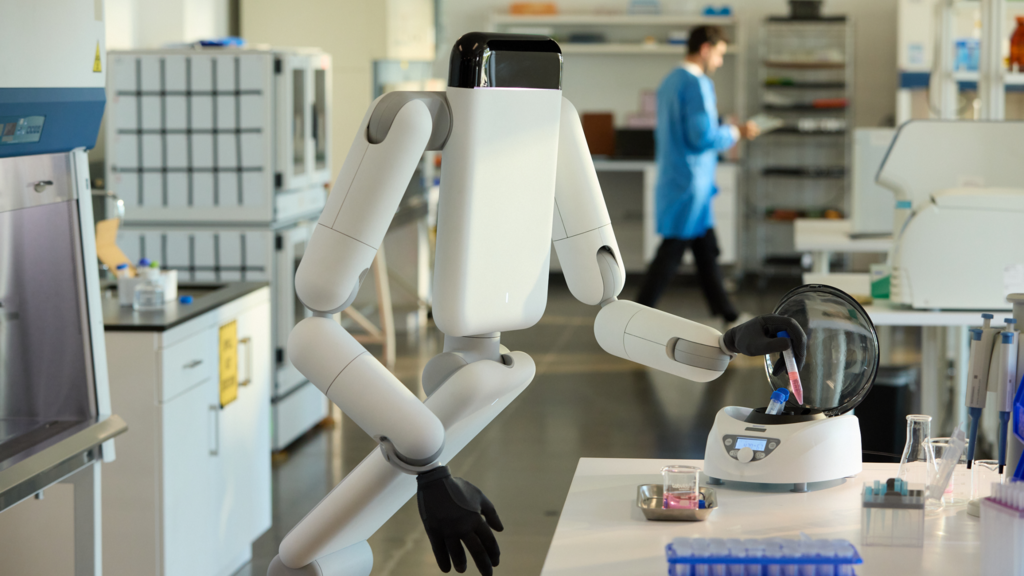
Genesis AI, the French robotics startup backed by former Google CEO Eric Schmidt, unveiled its first general-purpose robot on Tuesday, as AI capabilities expand beyond chatbots and into physical machines.
The robot, called “Eno”, breaks from the humanoid design usually favoured by leading manufacturers, featuring a wheeled base rather than legs, a foldable tower and hands that the company says match the form of a human hand.
Driven by advances in AI, the global robotics market is expanding rapidly, sparking debate over its impact on employment, though technical challenges, mostly about processing power and battery life, remain.
Read moreAnthropic disables access to top-tier AI models after US ban on foreign use
A Reuters/Ipsos poll this month showed 53 percent of Americans were concerned that AI would put them or someone in their household out of work.
Founded in early 2025, Genesis AI has raised $105 million (€90.6 million), one of France’s largest and matching the record seed round of Mistral AI – Europe‘s leading AI company. Genesis AI’s valuation was not immediately available. Eno runs on Genesis’s own AI model and is not built to look like humans, but to extend human capabilities, according to the company.
Genesis AI plans to begin production and targeted customer deployments by the end of 2026, starting with logistics and manufacturing customers, followed by hotels, hospitals and consumers.
In a statement, Schmidt said the robot’s breakthrough will not replace human expertise, but rather “amplify it” to unlock what he called “one of the largest economic opportunities of the AI era”.
Read more‘Human role narrowing’: Anthropic calls for global AI slowdown as systems could escape control
Genesis AI has built dozens of units so far and plans to scale up production in the second half of 2026, Vivian Sun, Vice President of Commercial and Strategy at Genesis AI, told Reuters. Sun said the wheeled base was chosen because most industrial customers operate on flat floors, adding that legs would only make sense for use cases like climbing stairs.
“We are mimicking humans in capabilities, not in form. Humans can go up and down, and so does the robot, but through this foldable design.”
(FRANCE 24 with Reuters)