


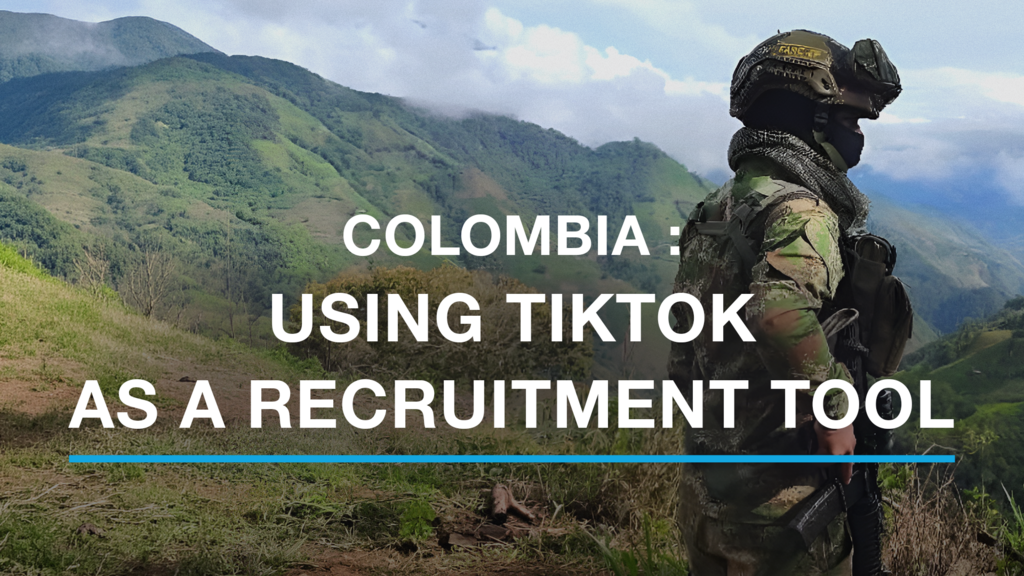
How armed groups in Colombia are using TikTok to recruit young people
How armed groups in Colombia are using TikTok to recruit young people
One of your browser extensions seems to be blocking the video player from loading. To watch this content, you may need to disable it on this site.


Reading time
6 min
As Colombia’s conflict has intensified in recent years, armed groups have flooded social media like TikTok with videos aimed at getting new recruits – particularly young people. The FRANCE 24 Observers team investigated the inner workings of this new recruitment method.
Wads of cash, gold watches and attractive young women: this is what life inside Colombia‘s armed groups looks like, at least according to numerous TikTok posts.
Some publications highlight the values these groups purportedly champion, such as “the defence of the people”, while others openly invite online users to join them.
The goal is to attract new recruits, especially young ones, who constitute the platform’s main audience.

Such posts have multiplied in recent years, spanning all of Colombia’s active armed groups – including dissidents of the former FARC guerrilla movement, the ELN (one of the country’s main guerrilla groups), and the Clan del Golfo (the biggest paramilitary group).
For these groups, recruiting new members is crucial, as the conflict has intensified over the last few years.

‘We found armed groups offering as much as 12 million pesos a month [€2,900]’
Lina Mejía Torres works for the Colombian NGO Vivamos Humanos, which released a report in early 2026 on the recruitment of young people through social media.
“We found armed groups offering as much as 12 million pesos a month [Editor’s note: €2,900 – seven times the Colombian minimum salary in 2026]. When you see that kind of pay in a region where there’s high unemployment, it gets attention. The groups target young people who are vulnerable, who aren’t in school.
The work they give kids is not just being a lookout or harvesting coca leaves; children are sometimes recruited for jobs like flying drones.”
‘How does it work if I want to join?’
Some of the TikTok posts get more than 100,000 views – and they also get comments. Some online users ask how to join the armed groups, and some social media accounts tell them to contact them via direct messages.

Our team created a fake TikTok account and contacted 33 accounts affiliated with the armed groups, primarily by posting comments or sending messages. We posed as a 17-year-old Colombian teen in order to see whether being underage posed a problem.
Six accounts responded; we exchanged messages to learn about their recruitment process and salary ranges. Several appeared willing to recruit a minor.

The recruitment and use of minors in armed conflict is a crime punishable by 23 years in prison, according to the Colombian penal code.
The UN reports that the number of children under 18 in Colombia’s armed groups climbed by 320 percent between 2019 and 2024.
However, no data is available on the exact number of young people recruited specifically via social media platforms.
‘They can reach the entire country from a base in a single place’
Online recruitment offers several advantages over traditional recruitment methods, said Juana Cabezas of the Indepaz human rights group. The Colombian organisation has studied forced recruitment by Colombia’s armed group alongside the platform Pacifista.
“Before, the armed groups had to be physically present on the ground to recruit minors. They’d go from house to house in an area, recruiting one or two minors [at a time] by force. Today, they can be omnipresent: they can reach the entire country from a base in a single place.
Recruitment via social media also goes largely unnoticed because children simply vanish, leaving their families completely in the dark about what happened to them.”
Mejía Torres told our team:
“Tracking down those involved in the recruitment is far more difficult because social media allows for anonymity. We won’t necessarily find out who is behind all of this or who is responsible.”
Recruiting online also offers a way to downplay the dangers.

‘The groups call their families to tell them to come pick up the children’s bodies’
We spoke to a member of an indigenous NGO in Cauca, the region with the highest number of young people recruited. We are hiding his identity for security reasons. He told our team:
“There are children who have joined the armed groups. One or two weeks later, the groups call their families to tell them to come pick up their body, because they’ve been killed.”
A report by the Colombian Institute of Legal Medicine says 30 minors under the age of 18 died between August 2025 and May 2026 – half of them in fighting between the armed groups, half in fighting with the military.

Accounts deleted, content replicated
Our team reviewed nearly a hundred TikTok accounts recruiting for armed groups. We found that they can remain active for a year or more before being taken down. And when they are deleted, their content often shows up on other accounts.
Moreover, when we first started our investigation, we used keywords to identify accounts affiliated with armed groups. But after just a day and a half, that was no longer necessary – our TikTok feed had become flooded with content related to these groups.
Yet, TikTok’s community guidelines ban “criminal organisations” and “supporting, recruiting for, or promoting these entities”. The platform also says it is protecting people under 18.
When contacted by our team, TikTok said it “takes proactive measures to stop the cartels using the platform, recognising that this is a very real challenge (…). Through specialised teams dedicated to dismantling these constantly evolving criminal networks, we strive to anticipate their new tactics and strictly apply our rules by deleting content and accounts that violate our guidelines.”
TikTok also said they “work closely” with the Colombian authorities.
Law designed to protect minors on social networks
In 2025, the Colombian parliament adopted a law concerning the “development of safe digital environments” for minors.
The NGO Vivamos Humanos says it is a promising first step. But the law has not yet gone into effect, and it does not mention recruitment by the armed groups.
The Colombian Ombudsman’s Office, also contacted by our team, said that the response should “include preventive measures (…) particularly in areas where armed groups are most present.”