


Trump pressures congressional Republicans by delaying landmark housing bill over voter ID push

US President Donald Trump said Wednesday he will refuse to sign a landmark housing bill unless congressional Republicans ram through the voting overhaul he has sought, exacerbating a clash with his party ahead of midterm elections.
Trump for months has been demanding passage of the SAVE America Act, a package that would impose strict new limits on elections, including requiring all voters to show proof of citizenship when registering to vote, and photo identification to cast a ballot.
Read moreBlonde, fervent and fake: Can AI-generated Trump fans boost him in the midterms?
In his zeal to get the reforms – criticised by Democrats as an assault on voting rights – across the finish line, he squashed what Republicans were hoping would be positive political optics: a high-profile ceremony featuring Trump and addressing the all-important issue of affordability.
“Today’s Housing News Conference and Signing is hereby cancelled until such time as we pass the desperately needed SAVE AMERICA ACT, which I consider to be a National Emergency,” Trump posted on his Truth Social platform, just two hours before the event at the US Capitol.
The election reform measure has already failed in the Senate, and critics say it is a blatant effort to suppress voting in Democratic-leaning communities.
Read moreDeaths in ICE detention more than double under Trump, analysis finds
But Trump, who still regularly airs his false claims that he won the 2020 election, has repeatedly demanded passage of the bill, even as Republican leaders explain there is little chance of it passing in the chamber due to Senate rules and a lack of support among some Republican senators.
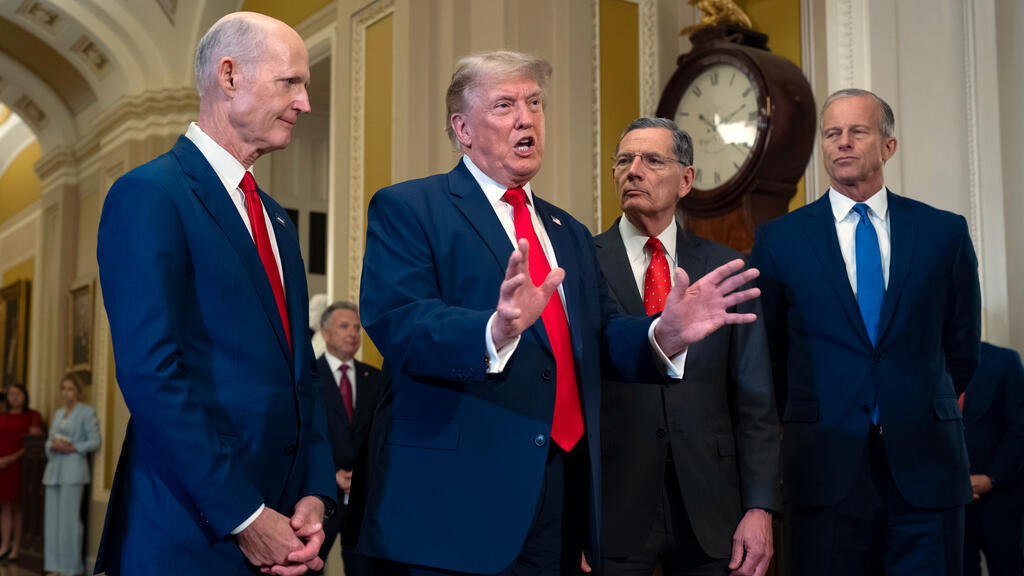
While he scrapped Wednesday’s signing ceremony, the president nevertheless trudged up to Capitol Hill to huddle with Senate Republicans at lunchtime.
As he walked with Senate Majority Leader John Thune, Trump largely ignored reporters’ questions about whether he would sign the housing bill.
Instead he volunteered without prompting that the Middle East “war is going very well” and that “Iran is making very big concessions.”
One of your browser extensions seems to be blocking the video player from loading. To watch this content, you may need to disable it on this site.

Late Tuesday, four Senate Republicans – acutely aware of the war’s political headwinds in an election year – joined Democrats in rebuking Trump by adopting a resolution ordering him to either end the war or seek congressional authoriqation to continue it.
‘Minor importance’
The new housing bill passed Tuesday with broad bipartisan support, including strong backing from congressional Republicans who have touted it as a key accomplishment on affordability heading into November’s midterm elections.
It is aimed at boosting housing supply, easing construction rules and expanding access to home ownership as high rents, elevated mortgage costs and a shortage of homes have become major political concerns.
Trump had been supportive of the package, given that it was meant to showcase his fight to lower the cost of living against a backdrop of persistent inflation driven in part by the war.
Read moreTrump slams ‘unpatriotic’ vote as House orders end to Iran war
But on Wednesday he grumbled that it is of “minor importance” and “pales in comparison” to passing the SAVE America Act.
Scrapping the bill signing earned rebukes on Capitol Hill, with Republican Senator Susan Collins calling it “disappointing” and saying the bipartisan housing bill “addresses a major problem.”
Trump’s refusal to sign may be mere political signaling. Under the US Constitution, if the president does not sign a bill within 10 days while Congress is in session, and he does not veto the measure, it automatically becomes law.
Last week Trump cancelled the Senate confirmation hearing for his nominee for director of national intelligence, arguing the election bill took priority.
Supporters of the measure believe it would strengthen US election security. But even with 14 states not requiring any form of identification to cast a ballot, including California and New York, voter fraud is exceedingly rare.
Critics point out it is already illegal for non-citizens to vote in US elections, and express alarm over the barriers being erected that could infringe on the voting rights of millions of Americans.
Many organisations warn that people from minority groups are the most affected by such restrictions.
(FRANCE 24 with AFP)