


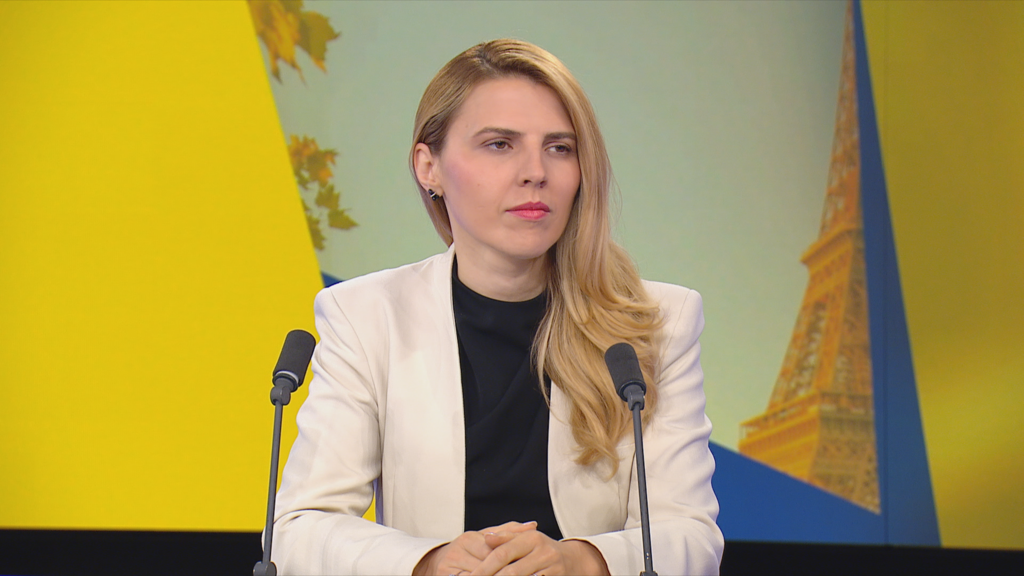
EU should not miss an opportunity on Ukraine diplomacy: Bulgarian FM Velislava Petrova
EU should not miss an opportunity on Ukraine diplomacy: Bulgarian FM Velislava Petrova
One of your browser extensions seems to be blocking the video player from loading. To watch this content, you may need to disable it on this site.

Play (12:45 min)

Reading time
3 min
Bulgaria has become notorious for holding elections. In 5 years, voters went to the polls 8 times. But this debilitating crisis finally ended on April 19th, when the Progressive Bulgaria party won an outright majority. It is led by the former president, Rumen Radev, now the prime minister.
He has pledged to continue on the country’s pro-European path, following Bulgaria’s entry into the Eurozone in January. But he has also called for pragmatism from the EU towards Russia, and a restoration of dialogue with Moscow – that has raised a few eyebrows in other European capitals. We welcome the new Bulgarian foreign minister, Velislava Petrova, who was appointed to the job in early May. She is no stranger to the foreign ministry, nor to European affairs, having been deputy minister of foreign affairs in three consecutive Bulgarian governments.
We begin by asking her about the government’s reform programme.
“We have a majority that we haven’t had in more than 20 years. We have a clear mandate from people to deliver on what they expect as the next phase of our European integration,” Petrova states. “We joined first the EU, then Schengen, then the Eurozone as well. People have given us a mandate to fight corruption, to establish the rule of law, and to have transparent working institutions. When it comes to the Recovery Fund, we actually managed to unblock the fourth installment of the RF (from the EU), exactly because the reforms in the judiciary were implemented extremely quickly. We were less than four weeks in government and all the legislation was pushed through. So this promise of judicial reform is already underway.”
We point out the dark cloud hanging over this pro-European path – The EU Commission recommending the opening of an excessive deficit procedure against Bulgaria, less than 6 months after the country joined the single currency!
“The previous governments acted mainly on populism rather than on true measures that were needed to maintain a healthy budget, and we’ll have to pay the price,” Petrova remarks. “For us it’s a very difficult path ahead. We don’t shy away from it, and we know that we’ll have to set very clear reforms and clear steps forward.”
Prime Minister Rumen Radev – seen by some pro-EU forces as being too sympathetic to Russia – has called for the EU to be pragmatic when it comes to talking to the Kremlin. Is this a significant shift?
“All we are calling for is for effective use of all three pillars; military support (to Ukraine), economic sanctions and diplomacy. The third one has been missing,” Petrova replies. “It does not show a very strong image when we are not able to speak between ourselves. We should focus on the question of under what terms do we sit at the table, what are the non-negotiables for us and for Ukraine, and how do we conduct those negotiations, and with what end result? We need to have those discussions internally. It’s been a bit too long that we haven’t held them. I am happy to see that more and more leaders recognise the importance of this. But we need to be strong and united in the way we sit at the table. And we have to be clear that we shouldn’t miss an opportunity.”
When it comes to Bulgaria’s neighbourhood and EU enlargement, Petrova points out that “during our 2018 EU presidency, we were the country that put enlargement back on the agenda. So we absolutely believe that it should be a topic of high priority.” She elaborates; “It’s important that enlargement does not create a sense of scepticism in some current (EU) members. Trust requires the sense that institutions are working in (candidate) countries. I think that the fundamentals: transparency, the rule of law, working institutions – these are the areas that are non-negotiables. So the merit-based approach needs to be the core that we cannot really step away from.”
Programme prepared by Aline Bottin, Oihana Almandoz and Perrine Desplats
