


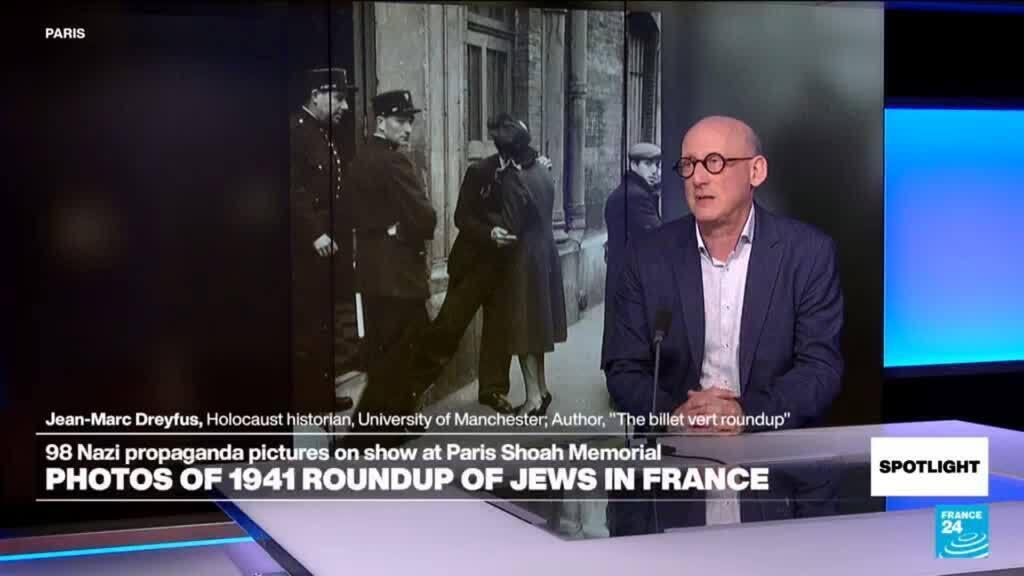
Holocaust remembrance: Newly discovered photos illustrate previously-unknown roundup of French Jews
Holocaust remembrance: Newly discovered photos illustrate previously-unknown roundup of French Jews
One of your browser extensions seems to be blocking the video player from loading. To watch this content, you may need to disable it on this site.


Reading time
2 min
François Picard is pleased to welcome Dr. Jean-Marc Dreyfus, Historian, Professor of Modern History at the University of Manchester, Chief Editor of ‘La Revue d’Histoire de la Shoah’ and one of the curators of the Shoah Memorial in Paris photography exhibit highlighting the discovery of 98 previously unknown photographs documenting the May 14, 1941 roundup of foreign Jews in Paris. It represents one of the most significant visual revelations in Holocaust historiography in recent years, the images capturing what Dr. Dreyfus calls “a real discovery for history, for our memory,” offering an almost minute-by-minute account of a largely forgotten precursor to the infamous Vel’ d’Hiv roundup of July 1942.
The photographs were taken by Harry Croner, a half-German, half-Jewish photographer employed by the German Wehrmacht’s propaganda apparatus. Yet the images transcend propaganda. Rather than celebrating state power, they reveal vulnerability, sorrow, confusion, and human dignity in the face of persecution. “You have a human grace. You have a human empathy,” Dreyfus observes, noting the profound irony that “none of the photos, the 98 photos, had been used at the time of the occupation.”
At the very centre of the collection stands a now-iconic image: a farewell kiss exchanged between a Jewish man summoned in the roundup and his partner. For Dreyfus, the photograph is especially haunting because it evokes Robert Doisneau’s celebrated image of romantic Paris while simultaneously inverting its meaning. Here, the kiss is not one of youthful love but of imminent separation, deportation and certain death.The photographs also expose the mechanics of persecution. Dreyfus describes the roundup as “a trap,” meticulously organised by Adolf Eichmann’s representative in Paris, Theodor Dannecker. Victims were summoned under the pretext of identity checks, only to discover that “once they were (rounded up) into the sports hall… they could not go out.” The images document both the deception and its human consequences: spouses returning with suitcases, children accompanying mothers, and French police enforcing German orders.Beyond their emotional force, the photographs challenge collective memory. While the Vel’ d’Hiv roundup has become a national symbol of Holocaust remembrance in France, the May 1941 operation remains largely absent from public consciousness. These images restore visibility to that forgotten episode while offering rare visual evidence of the hierarchy of occupation and collaboration. As Dreyfus remarks, “you see the Germans in command, and you see the French police administrators… abiding and obeying the orders.”What makes the collection extraordinary is precisely what made it unusable as propaganda. Croner, Dreyfus concludes, was “a great photographer” because “he shows what is not supposed to be shown”: the humanity of those targeted by a machinery of exclusion, deportation and death.
